What Building Habits Really Looks Like: Insights from The Atomic Habits Workbook
Since my last post introducing The Atomic Habits Workbook by James Clear, I’ve returned to world of work and settled back into my usual routine of school runs and the never ending cycle of household chores! This shift has prompted me to get back into some good habits and to focus on small actions I can take to support my wellbeing.
I’ve managed to carve out some time for daily meditation, thanks to Insight Timer’s meditation challenge, which has provided short, uplifting sessions each evening. Meditation really helps to calm my nervous system and grounds me after a busy day. After 5 or 10 minutes of a guided meditation I soon drift off to sleep.
I’ve also returned to gratitude journaling and writing down three good things from my day before bed. This small ritual gently shifts my mindset and ensures that, no matter how things have unfolded, I take a moment to recognise the positives in the day. Over time, it’s also become something comforting to look back on whenever I’m feeling low.
So, how have I fared with the new habits I wanted to build? Read on to discover the highs and lows of my habit change journey and the tips from The Atomic Habits Workbook* that have helped me the most.
*If you buy books linked to my site, I may earn a commission from Bookshop.org, whose fees support independent bookshops.
Assess your starting point
The next section of The Atomics Habits Workbook invites you to do an honest assessment of your life. The aim is to understand where you are, clarify what you truly want, and prioritise what you want to change first. If you would like to consider this further, one of my favourite coaching tools is the Wheel of Life, where you rate different areas of your life and explore how you would like to improve them.
The workbook also includes reflective questions about your current commitments and the projects you are already working on. This helps you to narrow down what really matters to you and to consider whether now is the right time to make certain changes.
With so many competing priorities in our lives, Clear dispenses a useful piece of advice:
‘Know what is important to you and it will grant you the freedom to ignore everything else.’
(James Clear, The Atomic Habits Workbook, p.51)
While working through these exercises, it dawned on me just how much I have going on. However, rather than feeling overwhelmed, I felt a greater sense of compassion for myself. With so many plates spinning, it’s no wonder I’ve found it hard to change my habits, especially as I can see that some of them are coping mechanisms for a busy lifestyle.
This leads to my confession…my healthy eating plan hasn’t exactly gone smoothly this month! If I’m honest, I’ve pretty much rebelled against it! I’ve succumbed to more than one takeaway and evening snacking has turned into a daily habit, mostly due to tiredness, convenience and far too much temptation around me.
Using Clear’s habit loop, here’s a typical example of how my unhealthy choices play out:
Cue: I arrive home from work feeling hungry and tired and notice a pizza leaflet on the kitchen counter.
Craving: I want to switch off, put my feet up, and enjoy something comforting while satisfying my hunger.
Response: I give in and order a takeaway.
Reward: I get to eat one of my favourite meals with almost no effort on my part, and I feel full and content.
Instead of beating myself up for giving into temptation, I’ve taken a leaf out of Clear’s book and treated my response as useful data that will help me to see what I need to change. For example:
- Throw away takeaway leaflets immediately (and unsubscribe from marketing emails while I’m at it).
- Make cooking dinner more enjoyable by putting on my favourite music or podcast.
- Stop putting off the food shopping; if I’m already popping into the supermarket for milk on the way home from work, I can pick up ingredients for dinner at the same time.
As Clear suggests, when temptation is an issue, small tweaks to your environment can make good choices easier and less reliant on willpower.
Time and energy reality check
Clear encourages you to track your energy levels and how you spend your time throughout the day. The idea is to help you spot the points in your day when you’re best placed to work on the changes you want to make.
I’ll be honest: I found the Time and Energy Audit hard to stick with! I have done similar exercises in the past and, unless the tracker is practically glued to me, I get so caught up in the day that I forget to fill it in. That said, the parts I did manage to record were genuinely illuminating!
The exercise highlighted that there are only so many usable hours in a day once you factor in work, responsibilities, and meeting your basic needs. It made me reflect on how much time I’m actually spending on the changes I want to make and where I might be losing time on things that add little value to my life. As Clear puts it:
‘Optimizing your time is not about figuring out how to use more hours in a day – it’s about figuring out how to maximize the ones you already have.’
(James Clear, The Atomic Habits Workbook, p.35)
What’s already worked for you?
One of my favourite parts of this process has been identifying the habits that are already positive and working well for me. I had several aha! moments as I thought about why my good habits have stuck, including:
- Starting with very small actions
- Making the habit easy to do
- Attaching it to an existing routine
- Making it enjoyable (where possible)
- Scheduling it
- Connecting it to my identity (‘I am a bookworm/gym bunny/ journaler’)
- Being patient and trusting that the benefits will come
Not only did this give me useful clues about how to build new habits successfully, it also showed me how I can adjust my current routines so that they serve me better. On the flip side, it helped me understand why some unhelpful habits have been harder to shift.
I also realised that I’ve built a lot of positive habits over the years and that deserves recognition! In this sense, the workbook strikes a lovely balance: it helps you to acknowledge how far you’ve already come while still encouraging your future growth.
The next section of the workbook focuses on goal setting and takes a deeper look at the first law of behaviour change: Make it obvious. I’ll let you know how I get on with all of that in the next few weeks!
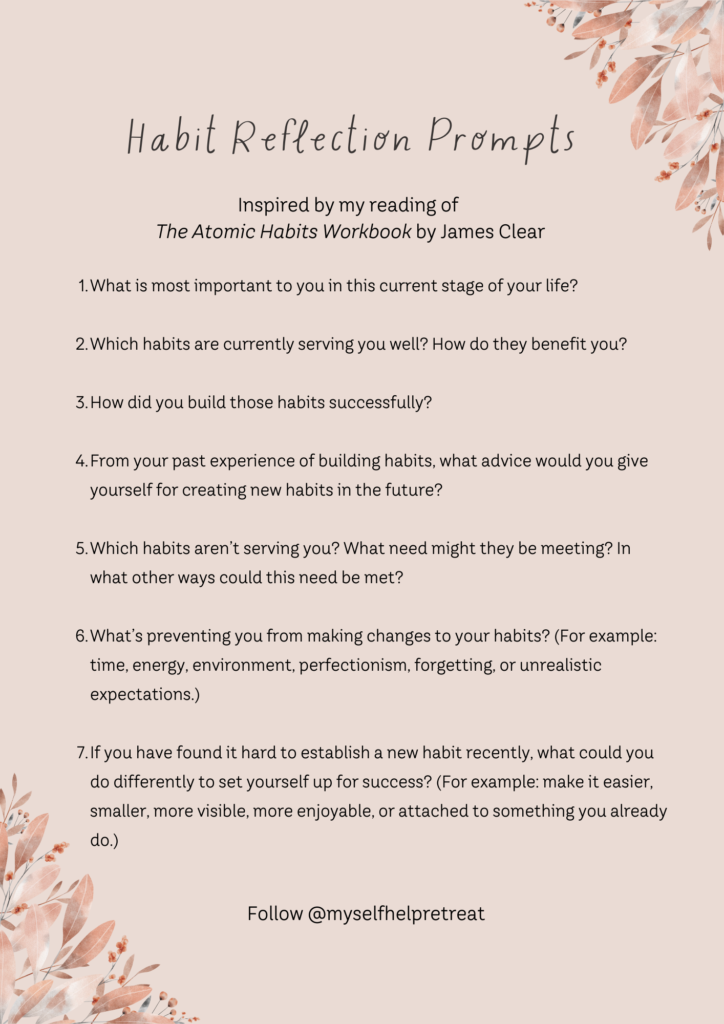
If you would like to reflect on your own habits, here are a few prompts to explore in your journal: