Embracing the Simple Life!
Between our day-to-day commitments and the unspoken pressure to ‘have it all’ – the latest gadgets, a spotless house, a nice car, packed social calendars, and a thriving career – it’s hardly surprising that life can feel exhausting and overwhelming. No wonder so many of us find ourselves daydreaming about moving to a desert island and escaping it all!
A few years ago, I came to a point where I was sick of feeling like I was running on some kind of hamster wheel. My to-do list was overflowing with an array of obligations and tasks. I was constantly busy and distracted, and whenever I did force myself to put my feet up (usually flopping down on the sofa just before bedtime) I wasn’t truly resting. My mind was still thinking about all the things that hadn’t got done.
Rather than searching for more productivity hacks or savvy morning routines, I vowed to take a closer look at each area of my life to see what I could start to cut out. I wanted to eliminate the busyness and create more space to relax, appreciate my surroundings, and do the things I enjoyed.
Before long, I realised that what I had really been craving was simplicity.
What is a simple life?
The first question I asked myself was:
What does a simple life mean to me?
As I contemplated this question, my thoughts immediately turned to decluttering the house, spending less money and owning fewer things. However, it became clear that it was also about how I chose to spend my time and energy.
For me, a simple life meant:
- Focusing on the people and activities in my life that are most important to me
- Limiting information sources and spending less time on social media
- Prioritising tasks that genuinely make a difference and move things forward
- Reducing options to ease decision fatigue
- Accepting that I cannot do everything and setting myself realistic expectations
- Valuing time wealth over material wealth
- Living within my means and avoiding unnecessary spending
How to live a simple life
Naturally, I sought out a book for guidance and came across A Simpler Life* by The School of Life. Their books offer an interesting blend of history, philosophy and self-help tips, drawing on wisdom from the past and applying it to the present day. The book outlines a range of practical actions that can make everyday life feel a little less complicated.
*If you buy books linked to my site, I may earn a commission from Bookshop.org, whose fees support independent bookshops.
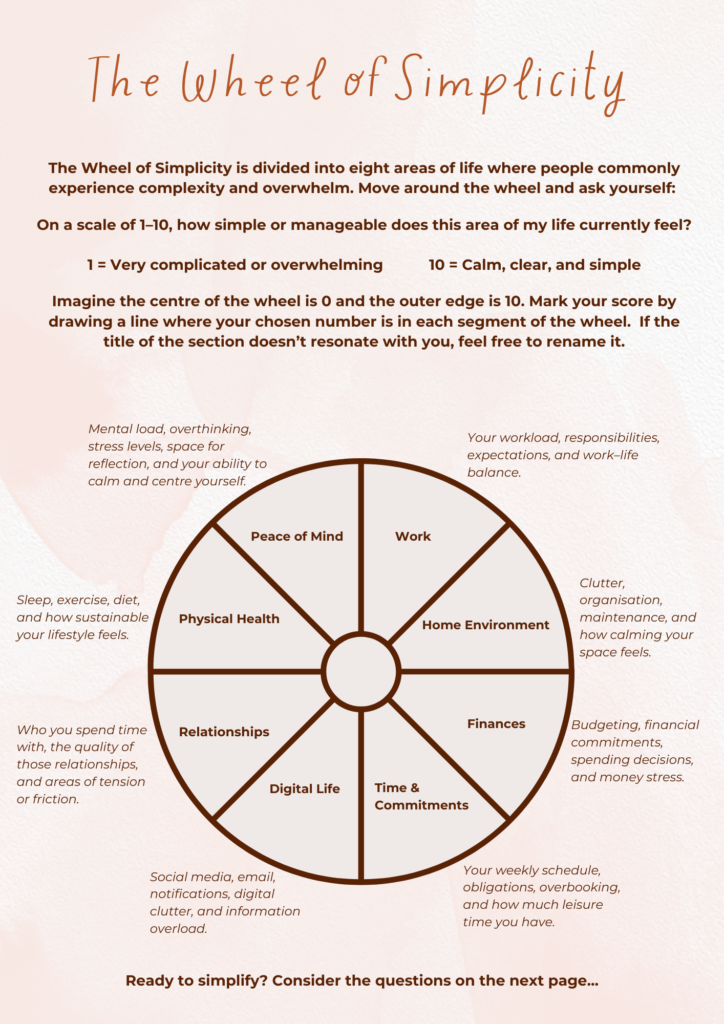
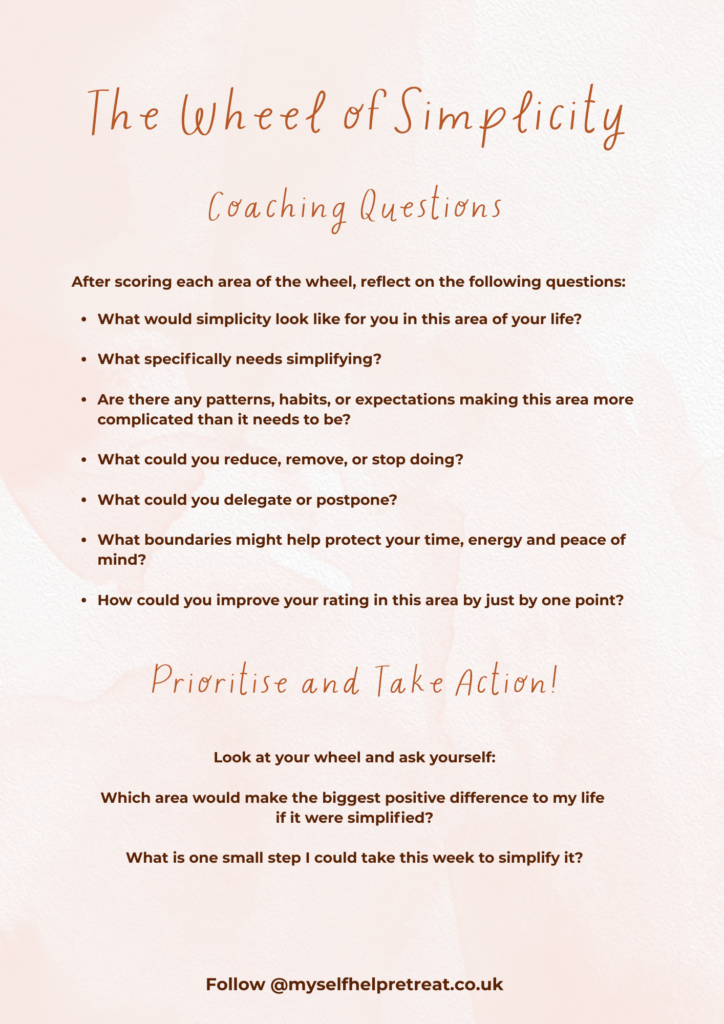
Read on to discover the key insights I took from the book and have a go at simplifying your own life by completing the free coaching tool, The Wheel of Simplicity.
Be congruent in your relationships with others
Our relationships can be a great source of fulfilment and joy. Yet when they are marked by conflict, dissatisfaction, or issues we avoid addressing, they can quickly make life feel messy and complicated.
Here’s how to simplify your relationships:
- Take time to understand your needs and what you want from the relationship (and then ask for it)
- Say no! Politely decline invitations or activities that you don’t have the time or energy to take on. You can say no to the request and still say yes to the person. For example, ‘Thank you for asking me. I can’t commit to that, but I’m happy to help you think through alternatives.’
- Communicate your feelings clearly and honestly. Using a feelings wheel can help you name and understand your emotions more precisely, making it easier to explain how you feel to others.
- Address issues early rather than letting resentment build, and work together to find constructive solutions.
- Spend your time with people who uplift you and genuinely care about your wellbeing. If there are people in your life you don’t quite gel with, or who tend to create friction, consider how you can limit the time you spend with them. If you do need to see them regularly, focus on activities you can both enjoy, set clear boundaries around what you will and won’t do or discuss, and steer conversations toward topics where you have common ground.
Be unashamedly yourself!
Life can feel deeply out of alignment, and incredibly exhausting, when we try to live up to other people’s expectations and standards. We may become so accustomed to pleasing others, worrying about their opinions, and constantly comparing ourselves that we gradually lose sight of our own preferences, dreams, and desires. This can leave us feeling disconnected from what truly feels right for us.
Instead, take some time to reflect on what really matters to you and what you find interesting and enjoyable. Embrace those things and make space for your hobbies! Recently, I’ve returned to my love of history, literature and dance. Prioritising those passions has made me feel happier and helped me rediscover a part of myself that felt lost.
You don’t have to follow the crowd! Focus on what makes you unique. Get clear on your core values, follow your interests, and uncover your authentic self.
Reject Busyness
We often wear busyness like a badge of honour. I’m probably the world’s worst for this… still waiting for my medal! Despite all the messages we receive about the virtues of working hard, you don’t have to be busy all the time.
Take a moment to look closely at the activities filling your calendar and sitting on your ‘To Do’ list:
- What is an absolute priority for you?
- What can be removed entirely?
- What could be delegated?
- What could be postponed?
Remember: You are a priority too! Give yourself permission to set tasks and chores aside, even if it’s just for a few hours. Allow yourself the occasional day where you do very little or just the things you enjoy!
Be careful what you say ‘yes’ to
Inspired by the exercises in The Atomic Habits Workbook by James Clear, I’ve been reflecting on how I want to spend my time and deciding what activities I actually want to be involved in. It can be incredibly helpful to pause and reassess your commitments, especially when overwhelm creeps in and you find yourself wishing for more hours in the day. It’s also valuable to do this when you want to create space for your goals or make other meaningful changes in your life.
Being selective helps ensure the things we agree to align with our values, priorities, and the time we realistically have to give.
Embrace JOMO! (The Joy of Missing Out)
As well as recognising that you don’t need to get involved in every activity or event that comes your way, notice any pressure you may be feeling to keep up with the latest trends, technologies or products.
Sometimes there is real satisfaction and pleasure in stepping back, saying ‘no thanks’, and missing out! As mentioned earlier, focus on identifying the activities that genuinely align with who you are, and give your time and attention to those rather than worrying about what everyone else is doing.
Declutter your environment
A cluttered living environment can quickly become a source of stress and it only creates more cleaning and tidying for you or someone else later on. Keeping things minimal and organised helps maintain a calmer space and reduces the time and effort spent having to deal with mess.
Simplify your living space by:
- Clearing the decks – Get rid of any unnecessary, outdated, or unused items that add no real value to your home or your life. Consider selling, donating, or recycling them.
- Choosing quality over quantity – When bringing new items into your home, prioritise well-made pieces that will last rather than accumulating lots of lower-quality things.
- Buying with intention – Only purchase items that are useful or meaningful to you in some way.
- Streamlining your wardrobe – Reduce the contents of your wardrobe and buy a few versatile, high-quality staples. This makes getting dressed quicker and easier in the morning!
Curb your spending
The more financial commitments we take on, the more pressure we feel to maintain our lifestyle and status, and to keep working to pay for it all.
Unfortunately, that often means less time with loved ones and fewer opportunities to relax and recharge, which can gradually take a toll on our mental and physical health.
Take a good, honest look at your outgoings. Keep the essentials and anything that genuinely adds value to your life, but identify where you could cut or reduce spending. Lower expenses can ease financial pressure and reduce the need to work long hours just to cover the costs.
When you feel the urge to splurge, it can help to pause before making a purchase. Step away for a few minutes before adding something to your basket. Then ask yourself a few simple questions:
- Why do I want this?
- What need or purpose will it serve?
- What does it mean to me?
Taking time to reflect can often be enough to help you make more aligned and intentional spending decisions.
Practise being present
Take pleasure in the ordinary. Appreciate the small things in your life and in the world around you. Slow down enough to notice and savour the little details: the quiet activity of wildlife, an interesting building you pass each day, the familiar sounds and smells of your favourite restaurant or cafe, or the simple comfort of sitting down with a cup of tea after a busy day.
There is much to appreciate and marvel at when you pay attention and most of it costs nothing at all. The ability to find satisfaction and wonder in everyday moments, without needing to chase extraordinary or expensive experiences, is a superpower!
Protect your peace of mind
In an incredibly noisy world, this is essential. I strongly recommend that you take time for a digital detox and be intentional about curating your social media feed. I’ve removed any accounts that feel negative or that are not aligned with my values, views or interests. Now my feeds are filled with the things I genuinely want to see: delicious recipes, travel inspiration, arts and crafts, music, and book recommendations. It’s become a pleasure to scroll through, rather than something that leaves me feeling emotionally drained.
It also helps to keep your distance from the constant stream of energy-sapping news. Stay informed about what truly matters to you or what you need to know but give yourself permission to switch off the rest.
I still have some way to go, but I’m gradually moving towards a simpler existence. I’ve realised that a simple life isn’t just about being frugal and clearing out all my physical clutter, it goes much deeper than that. It’s about being intentional with what I choose to fill my life with, taking a step back to consider which activities and commitments are truly necessary, and recognising what is genuinely meaningful to me.
Here’s to living a simple life!